Epoxy flooring South Africa guide: how the main systems differ, where each one works and what to check before you hire. To get prices for your own floor, send one request through Epoxy Flooring South Africa.
Know what you need? Request quotes from independent epoxy flooring contractors.
Request Free QuotesWhat an Epoxy Floor Is
Epoxy is a two-part resin. Mixed with its hardener, it cures into a hard plastic layer that bonds to prepared concrete. Systems range from thin rolled coats of well under 1 mm to trowelled mortars of 6 mm or more. Thickness, not colour, decides how much wear a floor takes.
Epoxy Systems Compared
| System | Typical build | Best for |
|---|---|---|
| Roller coat | Under 1 mm, two coats | Light traffic, budget garages, storerooms |
| Self levelling | About 2 - 4 mm | Smooth, seamless floors in shops, labs and homes |
| Flake | Base coat, flakes, clear topcoat | Garages, change rooms, kitchens |
| Metallic | Base coat, metallic coat, topcoat | Showrooms, homes, retail |
| Non slip | Any system plus aggregate | Wet, oily or sloped areas |
| Epoxy mortar | 4 - 6 mm and more, trowelled | Heavy impact and industrial wear |
Choose by Floor Type
- Garages. Hot tyres, oil drips and grit. Preparation decides how long it lasts.
- Homes. Looks, comfort and easy cleaning, with rooms closed off for a few days.
- Shops, offices and showrooms. Customer traffic and installation outside trading hours.
- Factories and workshops. Loads, impact, chemicals and shutdown planning.
- Warehouses. Forklift lanes, loading areas and line marking.
- Existing floors. Peeling, worn or cracked coatings diagnosed and repaired.
Epoxy, Polyurethane, Polyaspartic and Other Resins
| Resin | Strengths | Limits |
|---|---|---|
| Epoxy | Strong bond, hard, good chemical resistance, wide range of systems | Yellows and chalks in sunlight; rigid |
| Polyurethane | More flexible, better scratch and UV resistance, common topcoat | Thinner on its own; sensitive to moisture when applied |
| Polyurethane cement | Handles hot washdowns and thermal shock | Textured look; mainly food and wet industry |
| Polyaspartic | Fast cure, UV stable, quick return to use | Short working time; costs more |
| MMA | Cures in hours, even in cold rooms | Strong odour during installation |
Many floors combine resins, such as an epoxy base with a polyurethane topcoat. Ask every contractor to name the resin in each coat.
Surface Assessment and Preparation
- New concrete usually needs about 28 days to cure before coating.
- Moisture coming up through the slab is the most common cause of bubbling and peeling, so ask for a moisture test.
- Diamond grinding or shot blasting opens the surface so the coating can bond. Acid etching alone is less reliable.
- Cracks and holes are filled. Moving joints need a flexible filler, not a rigid one.
- Old paint, sealers and failing coatings are ground off. Tiles are removed or prepared to suit the system.
Installation Process
- Clear the area and protect walls, doors and fittings.
- Grind or blast, then vacuum the dust.
- Repair cracks, holes and joints.
- Prime the concrete.
- Apply the body coat, plus flakes, metallics or aggregate if specified.
- Apply the topcoat, then keep the area closed while it cures.
Curing and Return to Use
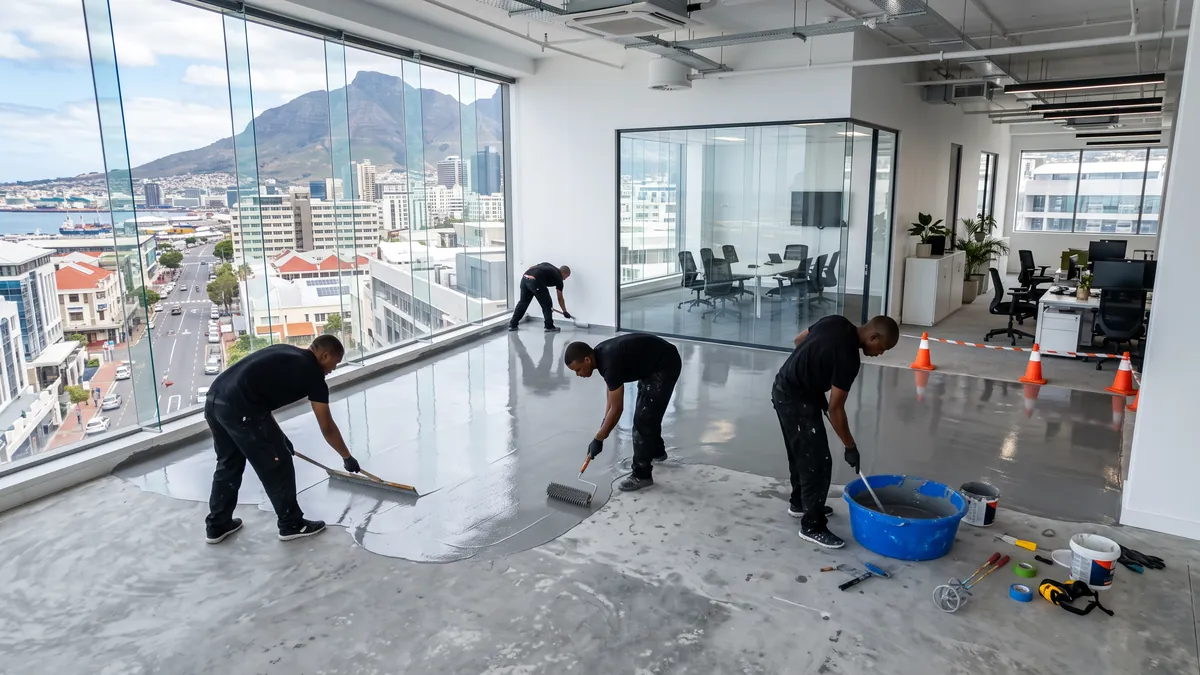
Many standard epoxy systems take light foot traffic after about 24 hours, vehicles or heavy loads after about 5 to 7 days, and reach full chemical resistance after about 7 days at around 20°C. Cold weather slows curing, and fast-cure systems are quicker. Ask the contractor for the times printed on the product data sheet for the exact system they quote.
Cleaning and Maintenance
- Sweep or dust-mop grit, which scratches gloss finishes.
- Wash with a pH-neutral cleaner and clean water.
- Wipe spills quickly, especially solvents, brake fluid and acids.
- Use mats at entrances and felt pads under furniture.
- Recoat worn traffic areas before the coating wears through to concrete.
Epoxy Flooring Prices by System
| System | Ballpark per m² |
|---|---|
| Entry-level water-based epoxy (1 - 2 mm) | R165 - R350 |
| Self levelling epoxy | R165 - R300 |
| Chemical-resistant epoxy (3 - 4 mm) | R350 - R1,000 |
| Decorative flake epoxy | R500 - R1,200 |
| Metallic epoxy | R700 - R1,500 |
| 3D epoxy flooring | R900 - R1,500 |
Prices JUST UPDATED. Ballpark figures per m² for supply and installation, taken from rates published by South African flooring contractors and cost guides and rounded. They are not our prices or quotations, and no contractor is bound by them. Most sources do not say whether VAT or preparation is included, so confirm both on every quote.
Sources:
- Kandua - epoxy flooring prices per square metre in South Africa
- Affordable Painters - cost of epoxy flooring
- Handyman Pretoria - epoxy flooring cost per m²
Preparation, repairs, area and access move the price. The epoxy flooring cost guide explains how contractors build a quote.
Epoxy Flooring FAQs
Which epoxy floor is best?
It depends on the use. Roller coats suit light traffic, self levelling gives a smooth finish, flake hides dirt and adds grip, and mortar systems take heavy industrial wear.
How long does an epoxy floor last?
It depends on preparation, thickness and traffic. A thin coat in a busy area may need recoating within a few years, while a well-prepared high-build system lasts much longer. Ask what the contractor expects for your use.
Can epoxy be used outdoors?
Most epoxies yellow and chalk in direct sun. Outdoor areas usually need a UV-stable polyurethane or polyaspartic topcoat, or a different resin altogether.
Is epoxy the same as polyurethane flooring?
No. They are different resins. Epoxy is harder and bonds strongly; polyurethane is more flexible and UV resistant. Many floors use both.
Do I need to be home during installation?
Not usually, but the area must be empty and closed off until it cures. Agree access, power and water with the contractor.
Specialist Pages
Epoxy Flooring South Africa is a free quote-comparison service. We do not install floors or employ installers. Work is quoted and carried out by independent flooring contractors, and your contract is with the contractor you choose. Ask each one for a written quote that names the system, thickness, preparation, warranty terms and timing before you pay a deposit.
Epoxy flooring quotes. Describe your floor once and compare replies from contractors.
Request Free QuotesRequest Free Quotes
Client Reviews
Powered by leaderr