
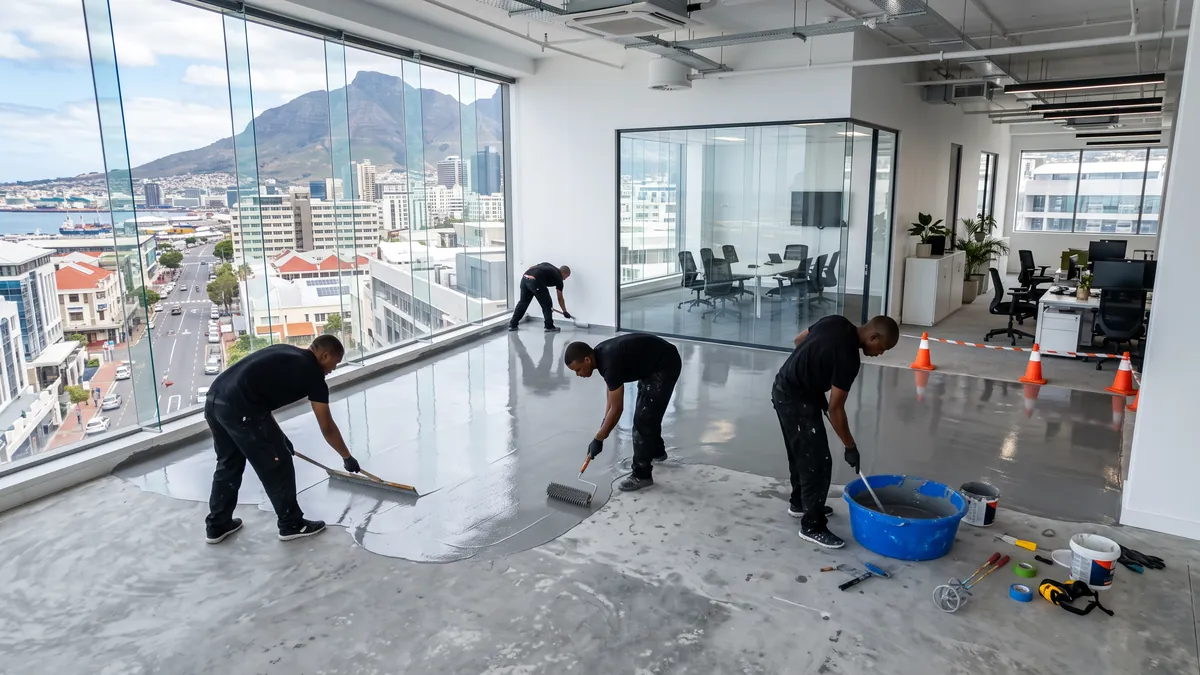
Industrial epoxy flooring South Africa: resin systems for factories, workshops and plants that must take heavy loads, impact and chemical spills. The right system depends on what actually happens on the floor, so be specific when you request quotes.
Describe your process, loads and chemicals to compare industrial flooring quotes.
Request Free QuotesConditions to Describe
- Mechanical loads. Forklifts, pallet jacks, steel or hard polyurethane wheels and point loads from machines.
- Impact. Dropped parts, tools and pallets.
- Abrasion. Grit, dragged loads and turning wheels.
- Chemicals. Acids, alkalis, solvents, oils and cleaning agents, with their concentration and temperature.
- Heat and water. Hot washdowns, steam, ovens and constant wet processing.
System Options
| System | Typical build | Use |
|---|---|---|
| High-build epoxy coating | About 0.5 - 1 mm | Light industry, assembly, storage |
| Chemical-resistant epoxy | About 3 - 4 mm | Plants with regular spills |
| Epoxy mortar screed | 4 - 6 mm and more | Heavy impact and abrasion |
| Polyurethane cement | 6 - 9 mm | Food plants, hot washdowns, thermal shock |
| Anti-static (ESD) epoxy | System specific | Electronics and explosive atmospheres |
Ask for the chemical resistance chart for the system and check it against your own chemicals. Epoxy is not the right answer for every industrial floor.
Assessment and Preparation
- Shot blasting or diamond grinding to remove laitance and contamination.
- Oil-soaked concrete may need cleaning, grinding out or a special primer.
- Moving joints are kept as joints with a flexible filler. Coating straight over them leads to cracking.
- Falls to drains are checked. A coating follows the slab and will not fix ponding.
- Weak or damaged concrete is repaired before resin goes down.
Planning a Shutdown
- Install during planned shutdowns, weekends or holidays.
- Split the floor into zones so part of the plant keeps running.
- Fast-cure systems can shorten downtime.
- Control temperature and humidity, as cold and damp slow curing.
- Agree a sign-off point before machines and racking return.
Industrial Flooring Prices
| System or area | Ballpark per m² |
|---|---|
| Warehouse or factory, standard system | R180 - R350 |
| Workshop or automotive | R220 - R400 |
| High-build or chemical-resistant epoxy | R350 - R1,000 |
| Polyurethane chemical-resistant (3 - 4 mm) | R350 - R600 |
| Polyurethane chemical-resistant (6 - 8 mm) | From R450 |
| Non slip industrial finish | R280 - R500 |
Prices JUST UPDATED. Ballpark figures per m² for supply and installation, taken from rates published by South African flooring contractors and cost guides and rounded. They are not our prices or quotations, and no contractor is bound by them. Most sources do not say whether VAT or preparation is included, so confirm both on every quote.
Sources:
- Handyman Pretoria - epoxy flooring cost per m²
- Kandua - epoxy flooring prices per square metre in South Africa
- Affordable Painters - cost of epoxy flooring
Concrete repairs, joint work and shutdown timing often outweigh the resin cost. See the epoxy flooring cost guide.
Return to Service
Many standard epoxy systems take light foot traffic after about 24 hours, vehicles or heavy loads after about 5 to 7 days, and reach full chemical resistance after about 7 days at around 20°C. Cold weather slows curing, and fast-cure systems are quicker. Ask the contractor for the times printed on the product data sheet for the exact system they quote. Floors exposed to chemicals should reach full cure before the first spill.
Maintenance
- Use scrubber-dryers and cleaners approved for the coating.
- Clean up chemical spills promptly.
- Inspect traffic lanes and repair chips before water and chemicals get underneath.
- Recoat high-wear lanes on a planned cycle.
Industrial Epoxy Flooring South Africa FAQs
How thick should an industrial floor be?
It depends on loads, impact and chemicals. Light industry may manage with a high-build coating; heavy impact and wet processing need several millimetres. Ask why the contractor chose the thickness.
Is epoxy chemical resistant?
Against many chemicals, but not all. Resistance depends on the chemical, concentration, temperature and contact time. Check the product chart.
Can epoxy handle hot washdowns?
Standard epoxy can crack or soften under repeated thermal shock. Polyurethane cement is usually specified for hot washdown areas.
Can the work be done during production?
Usually in phases, with zones closed while they are prepared and cured. Odour and dust controls are needed near food or sensitive processes.
What about floor joints?
Moving joints should be kept and sealed with a flexible filler. A rigid coating over a moving joint will crack along it.
Related Services
Request industrial quotes through Epoxy Flooring South Africa and compare systems, timing and price side by side.
Epoxy Flooring South Africa is a free quote-comparison service. We do not install floors or employ installers. Work is quoted and carried out by independent flooring contractors, and your contract is with the contractor you choose. Ask each one for a written quote that names the system, thickness, preparation, warranty terms and timing before you pay a deposit.
Industrial Epoxy Flooring South Africa. Request quotes for your plant or workshop.
Request Free QuotesRequest Free Quotes
Client Reviews
Powered by leaderr